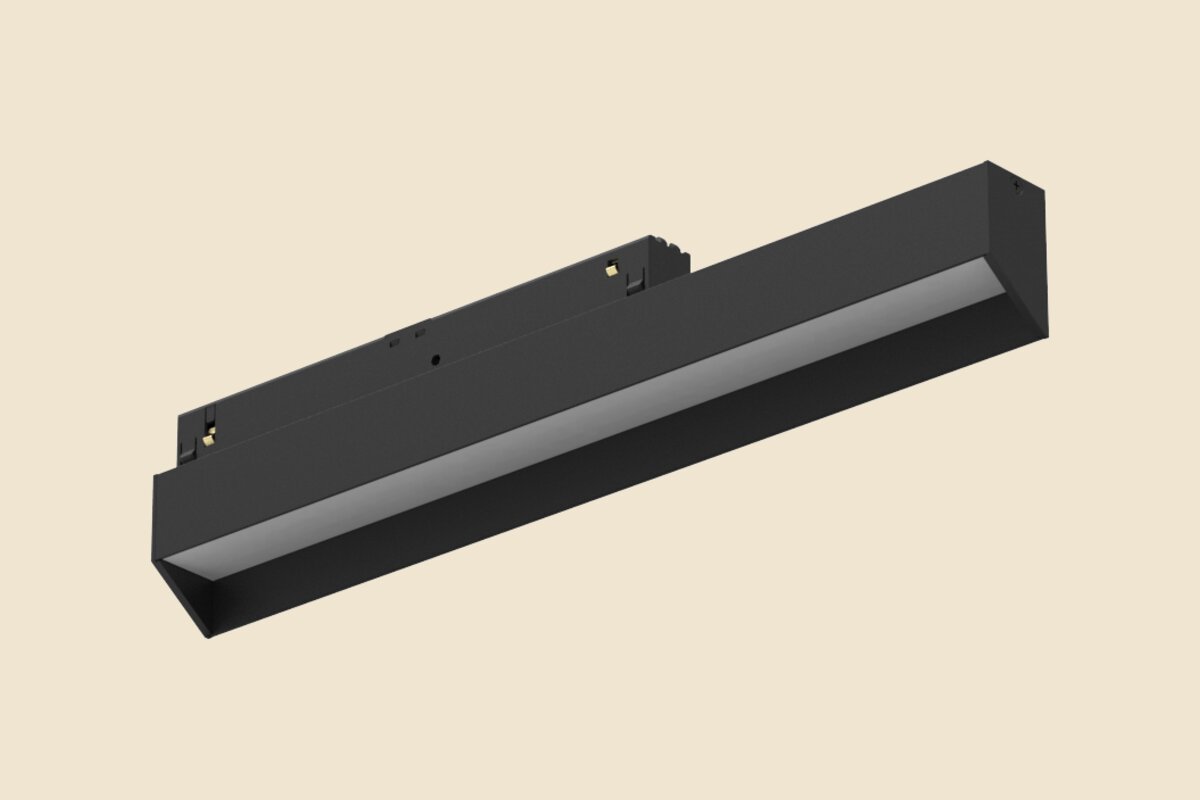
The optic you pick on a Senzafine EVO module can change its output more than fivefold and its glare rating from UGR < 16 to above 28, on the same body and the same 9500 track. So the choice is worth making on numbers, not on how the front looks.
Below are the figures from Stucchi's variant data for each optic, then a few notes on where each one earns its place.
The figures at 1125 mm, CRI 90
All rows are 3000 K. The wall washer does not come in 1125 mm, so it is listed at 565 mm.
| Optic | Length | Flux | Power | Efficacy | UGR |
|---|---|---|---|---|---|
| Narrow lens 20° | 1125 mm | 1617 lm | 21.4 W | 75.5 lm/W | < 16 |
| Medium lens 30° | 1125 mm | 1721 lm | 21.4 W | 80.4 lm/W | < 16 |
| Elliptical lens 26° x 42° | 1125 mm | 1490 lm | 21.4 W | 69.6 lm/W | < 19 |
| UGR reflector | 1125 mm | 2042 lm | 21.4 W | 95.4 lm/W | < 19 |
| Opal | 1125 mm | 1979 lm | 22.9 W | 86.4 lm/W | > 28 |
| Microprismatic | 1125 mm | 1388 lm | 22.9 W | 60.6 lm/W | < 25 |
| Fumé | 1125 mm | 360 lm | 22.9 W | 15.7 lm/W | < 25 |
| Wall washer | 565 mm | 1766 lm | 25.3 W | 69.8 lm/W | > 28 |
Lenses: narrow, medium or elliptical
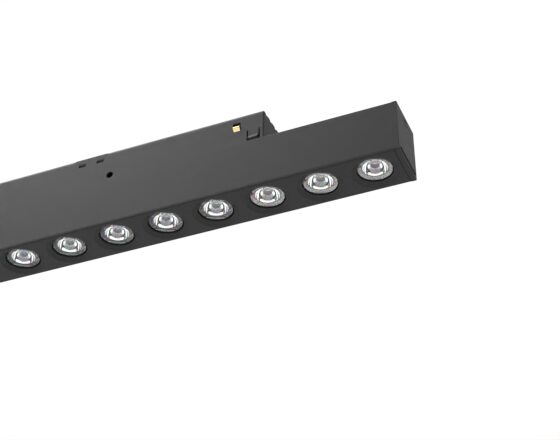
The lens version puts a polycarbonate lens over each LED. Narrow and medium both hold UGR < 16, the best glare figure in the range, so they work over desks and counters where people look up. Medium gives a little more light and spreads it wider. The elliptical lens stretches the beam along one axis, which helps light a shelf run or a long table evenly, at the cost of some output and a UGR of < 19.
At CRI 95 the lenses lose very little: the medium beam drops from 1721 lm to 1655 lm at 1125 mm, about 4%.
UGR reflector: the general lighting workhorse
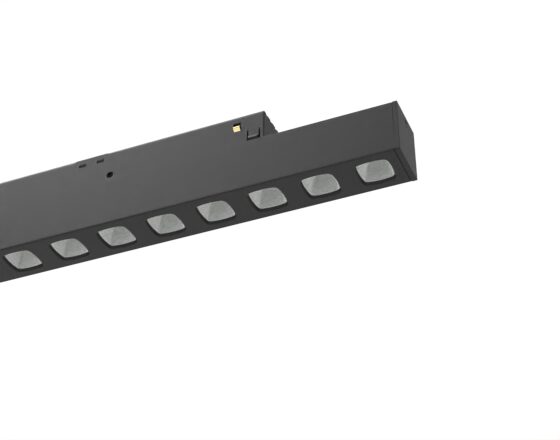
The UGR reflector is the most efficient optic in the family, 95.4 lm/W at CRI 90, while holding UGR < 19. For an office or classroom lit from track, this is usually the starting point.
Two things to know. First, CRI 95 costs more here than on the lenses: 1652 lm instead of 2042 lm at 1125 mm, roughly a 19% drop. Second, the 285 mm UGR module has high output versions, 1011 lm at 10.3 W (98.1 lm/W) and a high output plus at 1459 lm and 16.6 W, both at UGR < 22. That is a lot of light from a short piece, useful as a punch over a feature.
Opal, microprismatic and fumé
These three are screens rather than optics, and they run longer: 285 mm up to 1405 mm, where the opal gives 2474 lm at 28.8 W.
- Opal is bright and efficient (86.4 lm/W) and reads as one continuous line, but it is visible from everywhere (UGR > 28). Good in corridors, retail circulation and anywhere the line itself is part of the look.
- Microprismatic gives up about 30% of the opal's output to bring glare down to UGR < 25. A middle ground when you want a lit line rather than dots but the space has screens or long sightlines.
- Fumé is a smoked screen in a black body, 360 lm from 1125 mm. Treat it as a decorative glow, not a light source for tasks.
Wall washer: only 285 or 565 mm
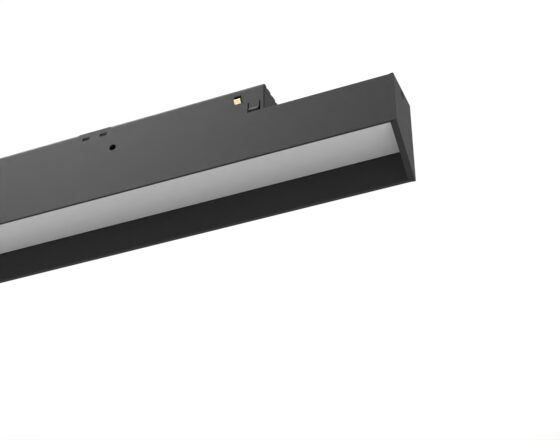
The wall washer throws light sideways onto a vertical surface. It only comes in 285 mm (883 lm at 12.7 W, or 1261 lm at 19.6 W in the plus version) and 565 mm (1766 lm at 25.3 W). For a long wall you set several modules end to end on the track near the wall, rather than ordering one long piece.
Picking one
A quick rule: reflector for general light, lenses where glare matters most or the light needs to land on something, opal where the line is the design, wall washer for the perimeter. Mixing them on one track run is normal. Browse the full set under Track Fixtures, or send us the room and we will put numbers against each option.