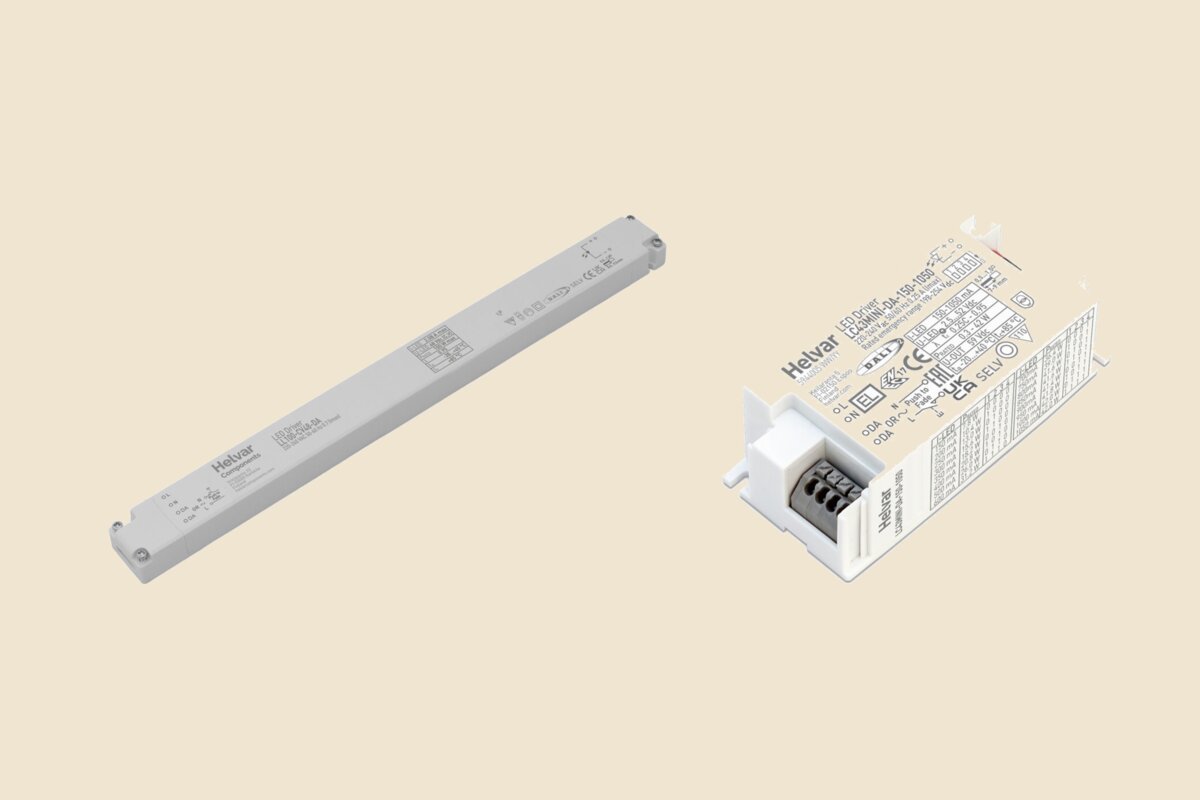
The load decides the driver, not the other way round. If the light source is a bare LED module or COB with no current control of its own, it needs a constant current driver. If it is a strip, a tape or a fixture with its own on-board electronics, rated at 12 V, 24 V or 48 V, it needs a constant voltage driver.
Most problems we see on site come from mixing the two up, or from choosing the right type but the wrong window. Here is how to tell them apart and what to check before ordering.
What a constant current driver does
An LED is a current-driven device. Its forward voltage moves with temperature and from one chip to the next, so the safe way to run a module is to fix the current and let the voltage settle wherever it needs to. A constant current driver does exactly that: you set a current, and the driver adjusts its output voltage inside a stated window.
The Helvar LL80HE-DA-100-800 is a typical example. Its output current can be set anywhere from 100 mA to 800 mA, by DIP switch (350, 500, 700 or 800 mA) or by NFC programming, and it delivers up to 80 W across a voltage window of 35 V to 330 V. The module's forward voltage at the chosen current has to sit inside that window, and the power has to stay under 80 W.
Constant current is the normal choice for downlights, spots, linear modules and anything built on COBs or LED boards where the luminaire maker controls the thermal design.
What a constant voltage driver does
A constant voltage driver holds its output at a fixed voltage and lets the load draw whatever current it needs, up to the driver's limit. The current regulation happens inside the load, usually with resistors or small regulators on the strip itself.
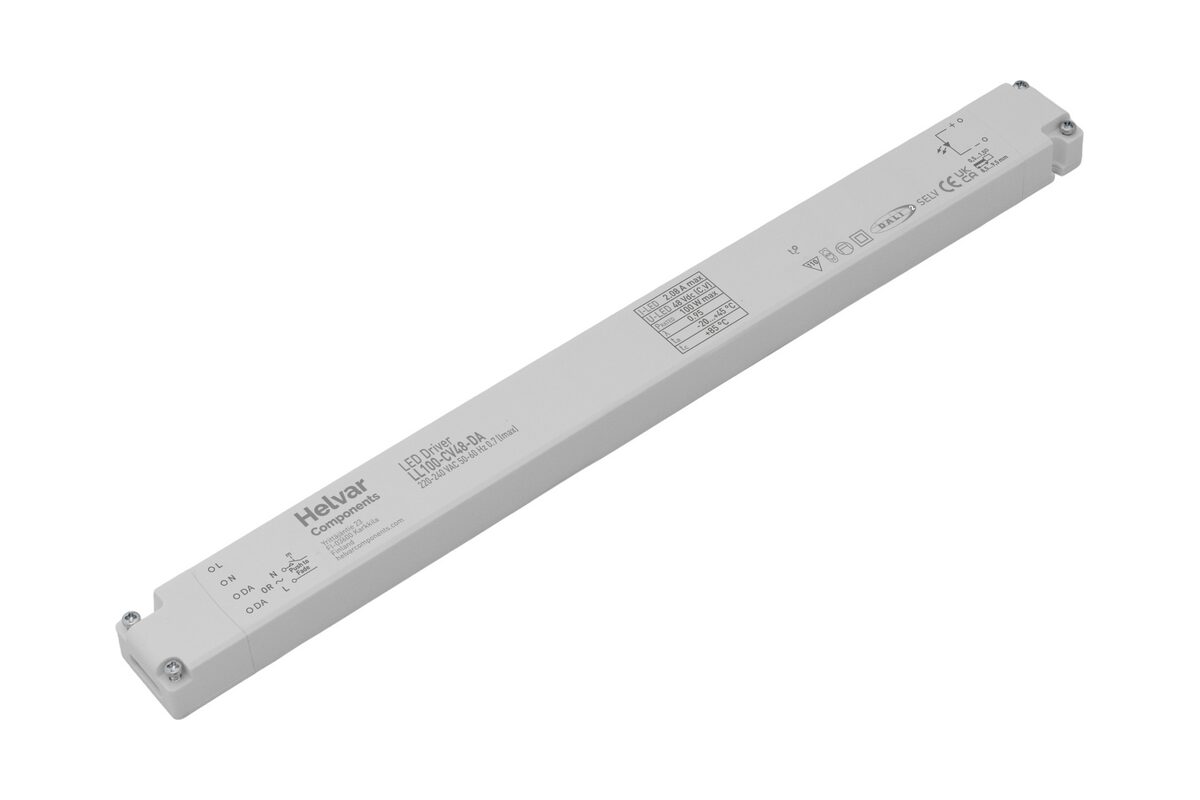
The Helvar LL100-CV48-DA supplies a fixed 48 V at up to 100 W (2.08 A), with DALI-2 dimming from 1 % to 100 %. Helvar's 24 V range includes the LL45-CV24-DA, LL80-CV24-DA and LL150-CV24-DA. Constant voltage is the norm for flexible strips such as COB.flex and Neon.flex, both 24 V products, and for low-voltage systems where several luminaires hang off one supply.
How to tell which one you need
- The label says a current (350 mA, 700 mA, 1050 mA): constant current. Match the current and check the voltage window.
- The label says a voltage (24 V DC, 48 V DC): constant voltage. Match the voltage and add up the watts.
- Bare LED board or COB with no components besides the LEDs: almost always constant current.
- Strip with resistors along it: constant voltage.
Never connect a constant voltage driver to a module that expects a fixed current. There is nothing on the board to limit the current, and the LEDs will be overdriven.
The practical trade-offs
| Constant current | Constant voltage | |
|---|---|---|
| Typical loads | Modules, COBs, downlights, spots | Strips, tapes, low-voltage systems |
| What you set | Output current | Nothing, voltage is fixed |
| Cable length to load | Short (1.5 m maximum on the LL80HE-DA-100-800) | Limited by voltage drop |
| Brightness along a run | Even, one module per channel | Can fade at the far end of long runs |
Voltage drop is the catch with constant voltage. Helvar's own datasheet for the LL100-CV48-DA advises against strip runs longer than 5 m because losses grow quickly. For longer lines, feed from both ends or split the run across several outputs.
Dimming works on both
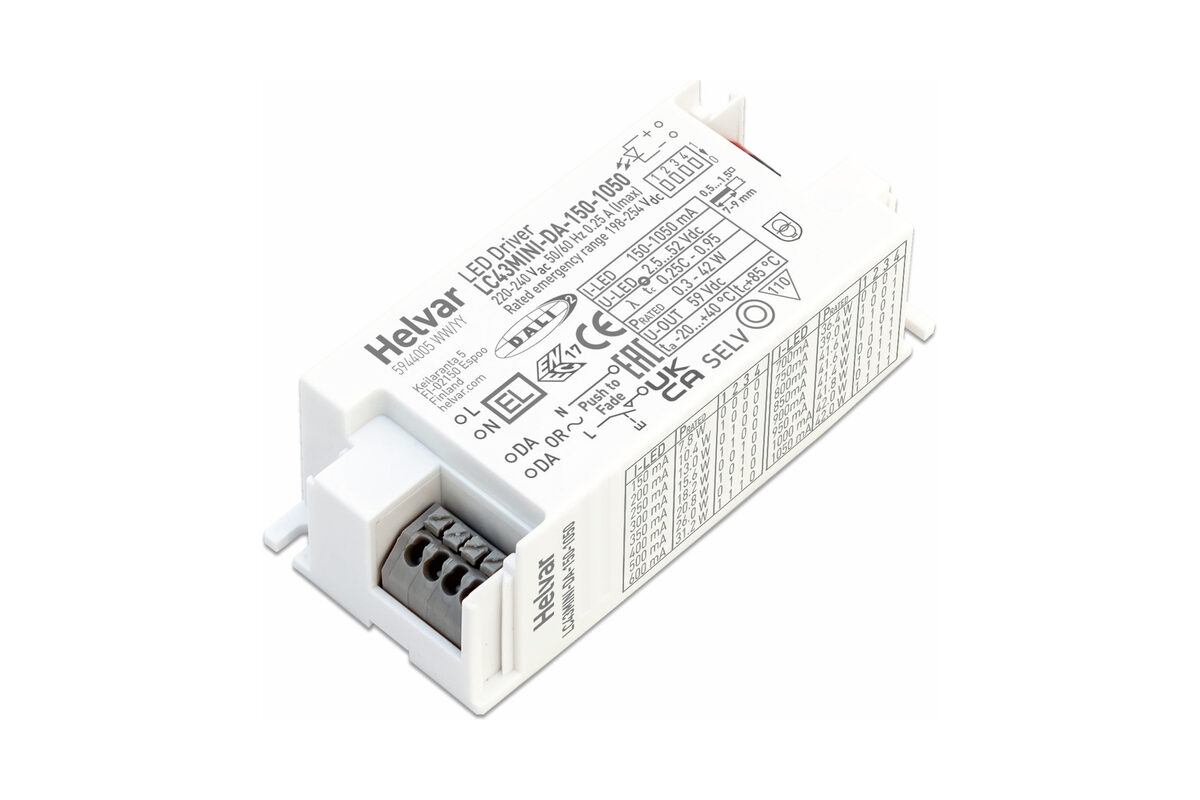
Both types are available with DALI-2. On the constant current side, Helvar DALI-2 drivers such as the LL80HE-DA-100-800 use amplitude dimming, which keeps the light free of visible flicker. The LL100-CV48-DA dims with PWM at 4 kHz, which is the usual approach for constant voltage loads. If the project involves cameras or very low dim levels, check the dimming method on the datasheet before you commit.
Not sure which way a luminaire or strip should be driven? Send us the module datasheet and we will match a driver from our LED components range, or get in touch directly.